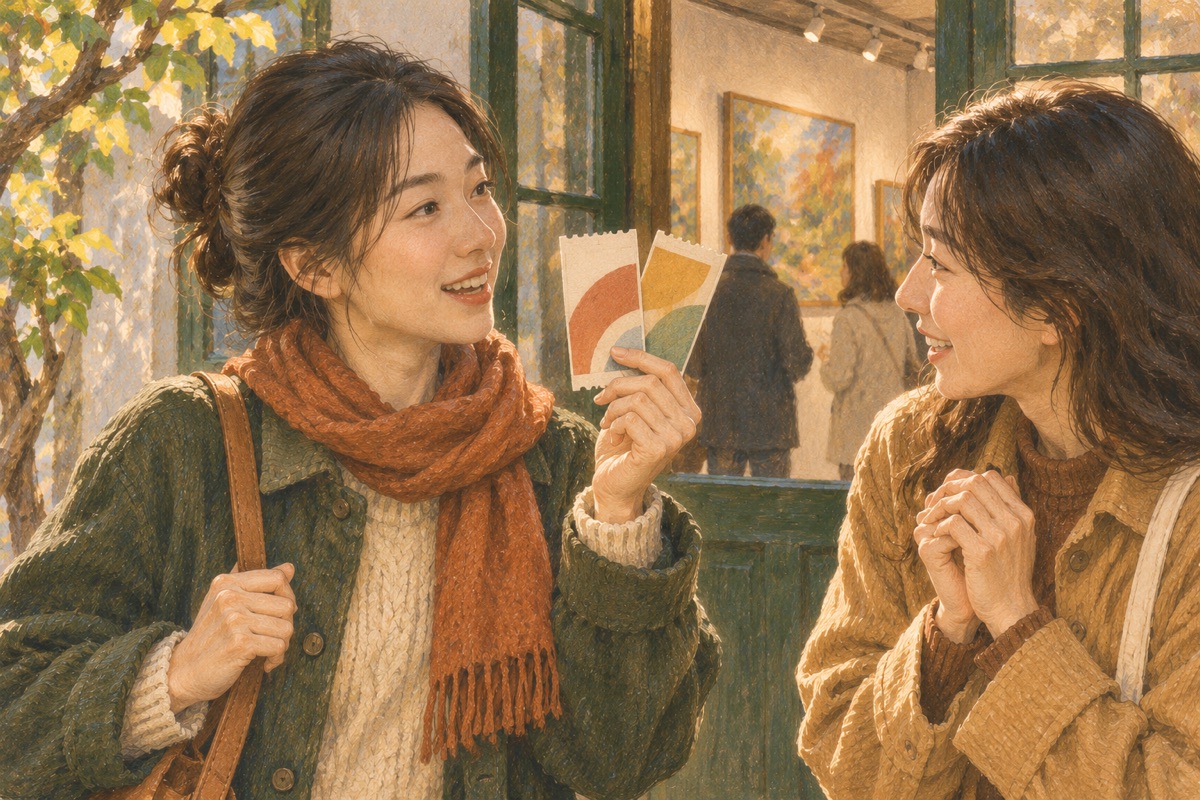
Use 有 to say that someone has something. It works with objects such as a pen, people in a family, and resources such as time. Start with the person, add 有, and then name the thing. The same verb works whether you are talking about one item or several.
Person + 有 + thing / Person + 没有 + thing
Start with who has it
有 connects the person to what they have. 两张 counts the two flat tickets; the negative is 没有.
When you give an exact number, Chinese usually places a classifier between the number and the noun. You can therefore build the object as “two + classifier + tickets,” then put that whole phrase after 有. You do not need to add a separate word meaning “a” when the context leaves the quantity unspecified.
The standard negative form is 没有, not 不有. This is worth learning as a pair from the beginning: 有 means “have,” and 没有 means “do not have.” You will also encounter 有 after a place to mean “there is” or “there are”; here, keep your attention on the person who has something.
张 is the classifier for these flat tickets.
有 works for ideas as well as physical objects.
An exact number is unnecessary when it is not the point of the sentence.
Common mistake
我不有雨伞。
我没有雨伞。
To say “I do not have an umbrella,” negate 有 with 没. The standard possession pattern uses 没有 even when you are describing the present, so 没 is not simply a past-tense marker.
Quick check
Check your answer here. Study saves progress when you practise grammar there.
Exercise vocabulary
Article vocabulary and the words required by grammar exercises can differ. In Study, choose Prepare exercise vocabulary to see the required set, then return to the same topic and check readiness.
04 / VOCABULARYLesson vocabulary
| Chinese | Pinyin | Meaning here |
|---|---|---|
| 展览 | zhǎnlǎn | exhibition |
| 想法 | xiǎngfǎ | idea |
| 钥匙 | yàoshi | key |
Choose a Chinese word for dictionary definitions, examples and stroke order. The meanings above are specific to this lesson.
What is in the download?
The TSV contains Chinese words, pinyin and meanings. Import instructions are below.
Visual examples by Laowai. AI-assisted illustrations.