

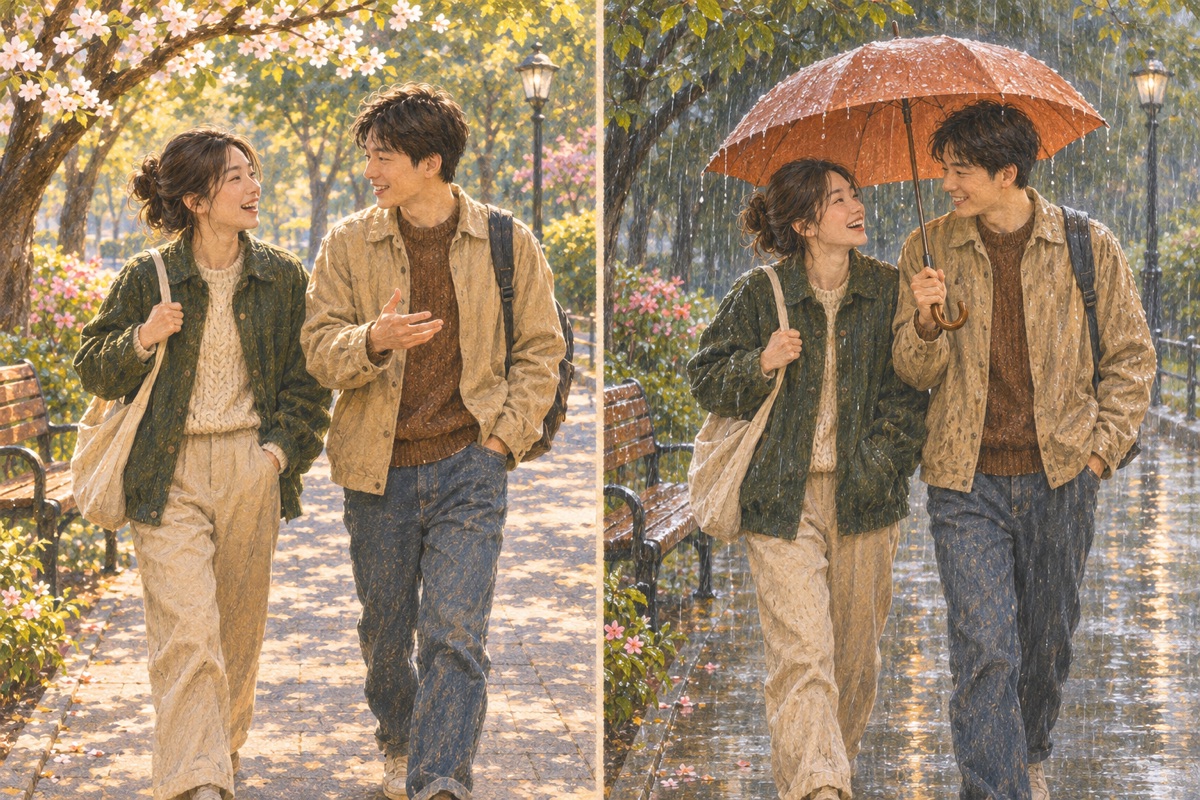
不管 presents a range of possibilities and says that the main result holds across them. The first clause can use a question word such as who, where, or what, or it can name alternatives joined with 还是. The second clause then states the rule, response, or decision that does not change. The question word is not asking for an answer here.
不管 + question word / alternatives,subject + 都 / 也 + unchanged result
Different conditions, one decision
The weather changes; the decision does not. 都 belongs to the main result, not to a question asking what the weather is.
都 or 也 usually marks the unchanged result before the predicate. Choose the subject position according to what is shared across the two clauses. 不管 is common in conversation and often sounds less formal than 无论. Keep this construction distinct from the verb meaning of not managing or not caring about something.
- Use question words to cover a range of possibilities.
- Connect explicit alternatives with 还是.
- Mark the unchanged result with 都 or 也.
Practise the pattern
Practise this topic with the app’s grammar exercises. Your answers and review dates are saved separately from vocabulary practice.
Exercise vocabulary
Article vocabulary and the words required by grammar exercises can differ. In Study, choose Prepare exercise vocabulary to see the required set, then return to the same topic and check readiness.
Look up the grammar words
Full reference and more examples
Used with a Question Word
Structure
Examples
Used with Two Different Options
Structure
Examples
Used with Adjectives
Structure
Examples
Source and editorial notes
Explanation rewritten for Laowai. Examples are adapted from the Laowai English grammar curriculum, with editorial corrections where needed. The original curriculum credits AllSet Learning’s Chinese Grammar Wiki as used with permission. Read the retained source credits.
Difficulty labels describe the level of the explanation; they are not official HSK placement. Send a correction with this page’s URL.
Visual examples by Laowai. AI-assisted illustrations.